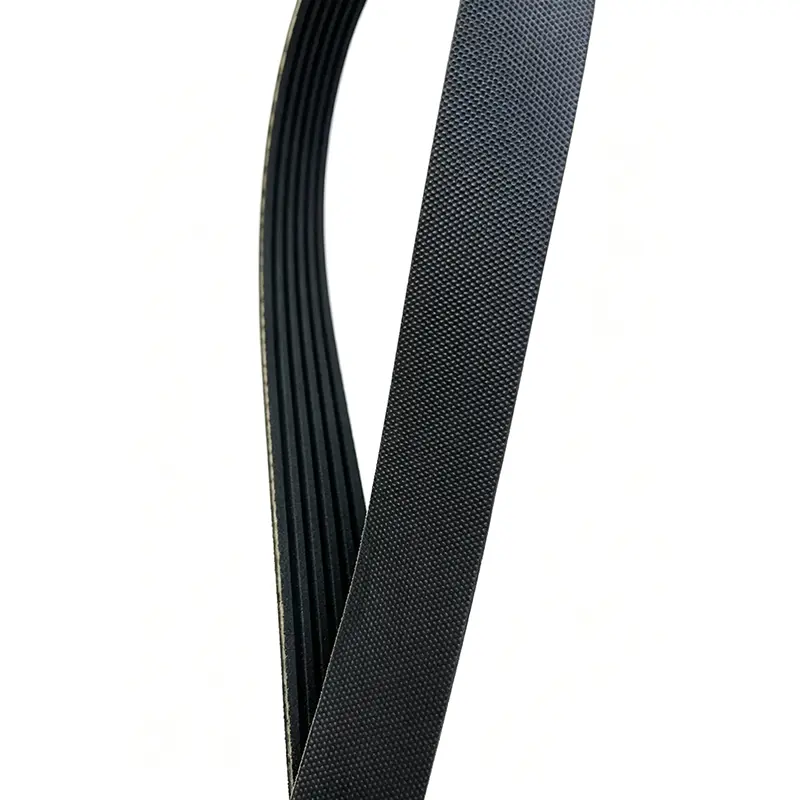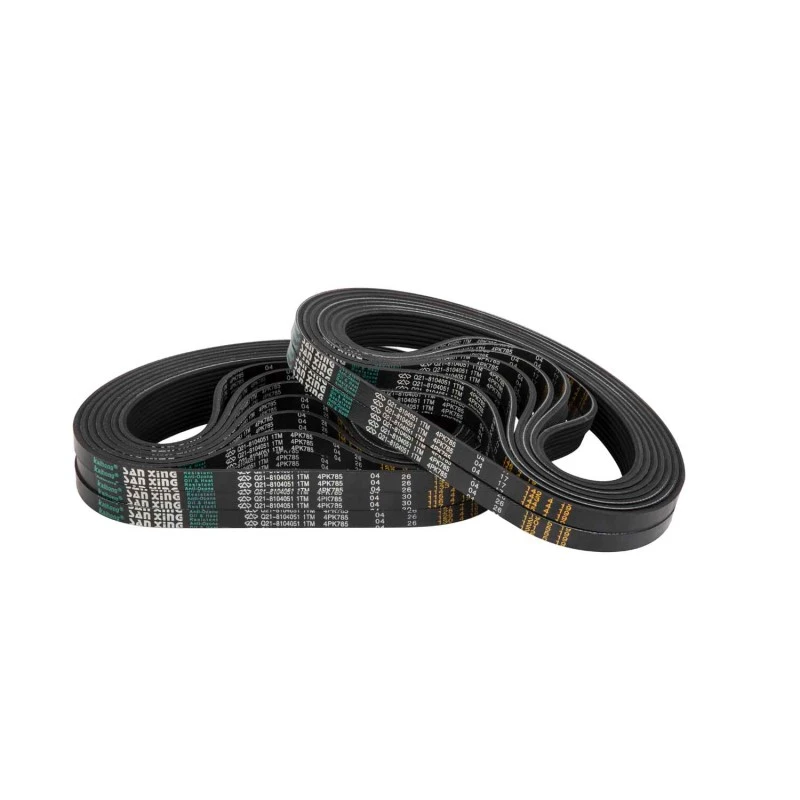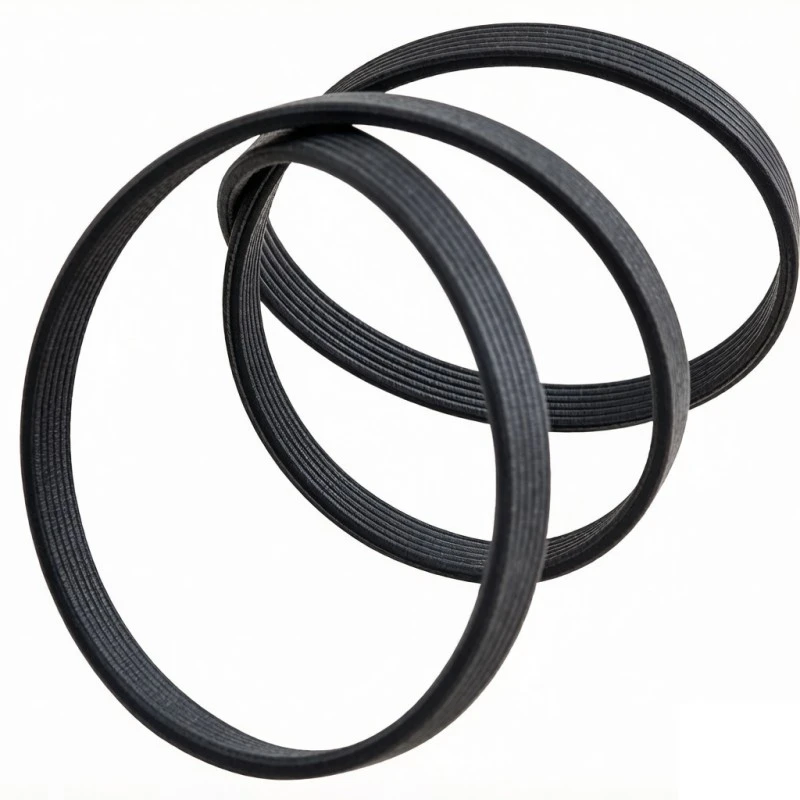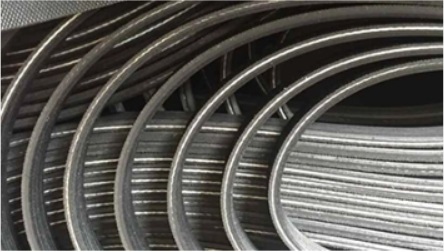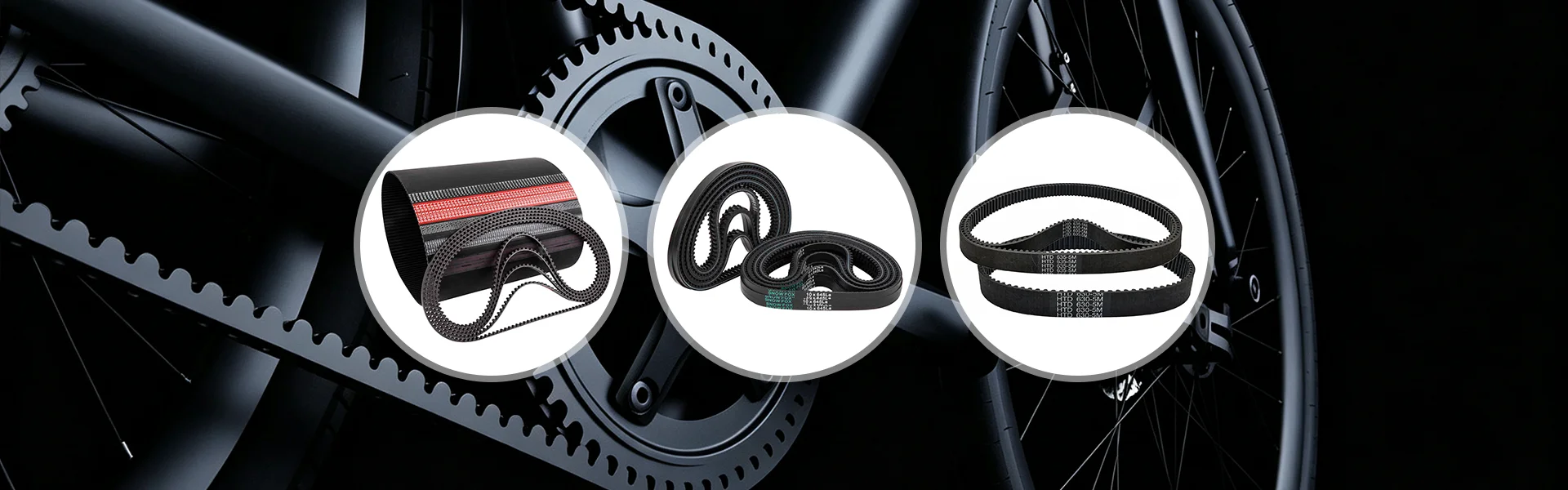
The inner surface of a poly V-belts consists of multiple longitudinal V-shaped ribs that mesh individually with the pulley grooves. This structure distributes load across several ribs rather than concentrating it on a single wedge face. At the same width, a multi-rib belt transmits more power than a single V-belt and permits smaller pulley diameters.
During procurement, note that the number of ribs corresponds directly to load capacity, but more ribs is not always better—pulley width, rib pitch tolerance, and belt lateral rigidity must match; in narrow-pulley scenarios with too many ribs, the edge ribs are prone to uneven loading.
During incoming inspection, do not check only the overall belt width. Verify that the rib pitch and the pulley groove pitch are within tolerance. Especially when reusing old pulleys, groove bottom wear prevents the new belt's ribs from seating fully, reducing actual contact area. It is recommended to sample-check with a groove gauge or pitch gauge rather than relying on visual inspection alone.
The thin cross-section of the poly V-belts results in lower bending stress on small pulleys, making it suitable for space-constrained layouts. However, the high bending frequency on small pulleys accelerates back cracking. During selection, confirm the minimum allowable pulley diameter stated by the supplier and leave a margin.
The belt body material of a multi-rib belt directly affects oil resistance, heat resistance, and aging performance. Rubber (chloroprene or EPDM) and polyurethane are the two common types. Rubber belt bodies offer good flexibility and low noise in general industrial environments; polyurethane belt bodies excel in oil and wear resistance but have lower low-temperature elasticity than rubber. Selection should be based on the media the equipment actually contacts, not on price comparison alone.
The normal operating temperature range of a chloroprene rubber belt body is approximately -25°C to +100°C, while EPDM systems cover a wider high-temperature end. If the equipment experiences short-term high-temperature exposure (such as near ovens or hot air ducts), confirm the heat resistance grade of the compound rather than looking only at the nominal continuous temperature.
Polyurethane multi-rib belts harden at low temperatures, and rib flexibility decreases. If the equipment starts in cold storage or outdoors in winter, confirm dynamic performance at low temperature, and if necessary switch to a rubber system or shorten the first tension inspection cycle.
An important feature of the poly V-belts is that one wide belt can drive multiple driven accessories, replacing several independent V-belts. This is clearly advantageous on equipment with complex layouts such as compressors, harvesters, and textile machinery: when the belt routes across multiple pulleys, the load of each driven pulley is carried by the same belt, avoiding uneven tension among multiple V-belts caused by length differences.
When replacing a poly V-belts in such layouts, an incorrect routing sequence results in insufficient wrap angle on some pulleys, manifesting as unstable speed or slippage on specific accessories. During acceptance, request the routing diagram for the corresponding machine model from the supplier, and confirm rib seating pulley by pulley after installation.
Multi-driven layouts usually include a tensioner. If the tensioner presses on the belt back, confirm its surface is flat without groove wear; if it presses on the rib side, a grooved tensioner must be used. Mixing the two causes local rib crushing.
The thin, flat cross-section of the Poly V Belt results in low centrifugal loss at high speed, with a linear speed limit of about 50 m/s. At high speed, the lateral rigidity of the belt becomes critical: a belt with insufficient rigidity will oscillate laterally at high speed, shifting the contact position between ribs and grooves, increasing noise and accelerating wear. When purchasing for high-speed spindle or fan drives, confirm the lateral rigidity specification rather than looking only at tensile strength.
If a rhythmic squeal appears at high speed, it is often not insufficient tension but lateral oscillation of the belt causing intermittent collision between ribs and groove walls. In this case, check pulley coaxiality and belt straightness rather than blindly increasing tension.
Above a certain linear speed, dynamic balance defects in the pulley itself amplify belt vibration. When replacing belts in high-speed drives, it is advisable to check pulley dynamic balance at the same time, avoiding misdiagnosing a belt problem as a pulley problem.
The tension setting for a multi-rib belt differs from that of a standard V-belt: the more ribs, the smaller the load per rib, but the total tension requirement does not increase proportionally. Over-tensioning causes back cracking and increased bearing load, while under-tensioning manifests as rib slippage and abnormal heat. Under the ISO 9001:2015 system, Kaihong retains vulcanization parameter records for each batch of belt body; purchasers may request batch data with the goods for consistency comparison.
After 24 to 48 hours of operation, a new belt undergoes a certain amount of initial stretch. It is recommended to recheck tension after the first run and adjust according to the tension table provided by the equipment manufacturer, rather than using the empirical values of the old belt.
Do not use belt wax or similar friction-enhancing products during installation. Such materials change the friction coefficient between ribs and grooves; while they may appear to reduce slippage in the short term, they accelerate rib wear over time and mask the real problem of insufficient tension.